请登陆我们的网站首页  VISIT THE MAIN HomeShop SITE


On the Problem of Transplantation
Julie Ren (julie.ren@hu-berlin.de) visited HomeShop in 2012 and spoke with Elaine W. Ho and Fotini Lazaridou-Hatzigoga about the various issues around initiating and sustaining art/project spaces in Beijing and Berlin for her Humboldt University dissertation research. While gentrification is not her area of research, it is something she is trying to approach critically, especially as a dominant framing of urban change. In preparation for an upcoming publication on the topic, she continued the discussion with Michael Eddy.

 
Julie: I’m still doubtful about applying the gentrification lens to Beijing, and I plan to focus my contribution to the book on the problems of transplanting urban concepts. To me, it’s a hermeneutic lens and it reflects the need to interpret urban change in terms of dominant academic canons—whether it’s global/mega cities, cosmopolitanism, network societies, mobility paradigms… or gentrification.

My doubt is two-fold. First, I’m skeptical about its being an accurate means to interpret the socio-economic and demographic changes in Beijing neighborhoods. Sure, many neighborhoods are visibly changed, there is high turnover of residents and prices are increasing. But is this the result of an urban gentry moving in to displace residents with a lower average income? With a view to neighborhoods such as Gulou and Wudaoying within the 2nd ring, this seems more a top-down business development scheme rather than a residential real estate-driven change. Especially in the Hutongs, I wonder about the issue of demographic change – to what extent is it income and to what extent is it elder residents being replaced with younger residents? To what extent are they being displaced, and to what extent are Hutong residents moving out to become new landlords? 

Secondly, I’m concerned about the embedded normative question of: Should we interpret urban change in Beijing in terms of gentrification? As I stated above, I think it’s a hermeneutic instrument that reflects the academic background and experiences of those seeking to understand urban change in Beijing. Moreover, there are assumed notions of urban inequality and social justice accompanying the term that allude to the realities of a neoliberal city in which mobility and privilege often function in tandem. Yet mobility in Chinese cities is a fraught issue, often a result of broad macroeconomic changes driving rural poor to find work in cities, exacerbated by remittance obligations and a lack of legal status. (A much more pressing issue of urban inequality might be Hukou reform rather than neighborhood-level change.) 
It just seems to me there are fundamental assumptions about gentrification that fail to account for the realities of the urban context in Beijing. I can understand why especially the growing international community in Beijing might be thinking in these terms, but I wonder if it doesn’t have more to do with them, than the city in which they live?
 
Michael: As for your first doubt, it is well-founded. However, I wonder where you can draw the line between the good-intentioned BoBos and top-down gentrification, even in Beijing. If you think of the Richard Florida school of thought and the thousand waterfront loft conversions and creative districtings it inspired toward the “creative cities” obsession, I would still need to consider the relation of that to possible forms of gentrification.

Perhaps I misunderstand the technicalities of the terms. But it is on the one hand often a rebranding and intensification of the gentrification already at work somewhere, as well as not totally predictable as to its effects. Some go with it and profit from it—but maybe now I am thinking of the experience of being in China. Mai Dian (a friend from Wuhan) has been involved in projects about development around East Lake, notably the privatization of once publicly accessible lands, including “Our East Lake.” For his contribution to the recently-released Wear journal 3, published by HomeShop, he discussed one of the problems in the activists’ resistance to the developments: that many of the farmers and other landowners who they would have hoped to share some solidarity with, had been more disarmed by the imagoes of “contemporary living” presented by the developments and ideas of progress than gathering together a concerted resistance.

Because of its action of government-aided corporate appropriation of large tracts of land, maybe it is not realistic to call this gentrification; my only curiosity is in this imaginary relation to development and contemporaneity. Maybe it would be absurd to humor the idea of a kind of “self-gentrification” though. This imaginary to aim for is brilliantly embodied in the fetishization and commodification of culture—with contemporary art sitting near the top. In many places, including China, art is braided within this tension; it is hard as an artist not to fall on the conspirators’ side at least sometimes.

Richard Florida’s insistence that the economic category of cities could be assessed and enhanced by the number of “creatives” (and homosexuals) is not totally inapplicable if you look at urban change in Beijing, which is not to say that his theories are correct (look at Martha Rosler’s text for an overview of the problems relating art to real estate).
To take a tasteless example, the 798 art district taking over the factory spaces near Jiuxianqiao Road was “authentically” started by artists, and only much later became an art district by edict. Art-inspired rebranding of a place with actual roots in artists first settling there is also taking place in Tongzhou, Caochangdi (which has so far miraculously managed to avoid being razed for at least 2 years since I heard the threat) and other far-out places. In these places, complex cooperation and co-existence between migrant workers, landlord and the art world takes place, though it surely totally disfigures their original states. I guess you could say these also launched a thousand top-down developed gated communities themed on art as well.

In our experience at HomeShop, it is a slightly different story inside the 2nd Ring Road. To some degree, there are the local administrative plans—and in some areas, like Dashilan, I should also mention there are at least nominal attempts to retain local character and occupants at least for the foreseeable future as an architecture firm (sorry can’t recall name at present) develops the area—but the aspect of cultural tourism predates that. (For instance, Nanluoguxiang, which is now the pinnacle of hutong tourism, may have been initiated by some locals, though at present I can’t substantiate this beyond hearsay and less than rigorous journalism.) You also see local hutong-dwellers making adjustments to benefit from the potential returns of tradition (Elaine mentions this in one of her posts on the HomeShop blog, though the residents she mentions aren’t well-to-do by most measures).
HomeShop also adds to the ingredients of the area, of course—I am not sure whether I mentioned an architect friend took over the space across the hutong that used to be an old Shouyi shop? I feel that is a pretty textbook gentrification move, assisted by our presence there to some degree, even if things like this only happen in pockets—but that’s how it happens, if I understand correctly.

So I agree that it is different in China, for instance these several levels co-existing sometimes precisely because they are so different (in the cases of migrant workers living next to fancy condo complexes… at least temporarily), and because of government involvement awkwardly fitting, but I do not think it is a normatively inappropriate to use the term in selected circumstances, especially those relating to culture.
 
“Artlife,” an upscale mixed use residential development under construction on a stretch of highway near Hangzhou, Zhejiang Province.
 
 
Julie: I’ll pick up with the idea you suggest at the end, of a selective application of gentrification to culture. The example of the architect displacing the Shouyi shop could certainly be a part of gentrification, but is it culturally-led gentrification? Or is it more simply economic? Gentrification and culture are connected in a multitude of ways, but I think most commonly, culture is seen as a driver of gentrification. And it’s this conceptualization of culturally-led or culturally-driven gentrification (in its pioneering activity) that most directly, most explicitly implicates artists and creative industry workers. It is rare, let’s say, for an artist or graphic designer or architect to push out a low-income shop in London. More common would be for them to inhabit available spaces in unkempt neighborhoods, rendering them attractive for the middle classes, the urban gentry, who in turn do the heavy-lifting in terms of displacement. This is at least the “common” example, but perhaps this is how Beijing differentiates itself – artists/creatives can directly displace lower income people. Whether the Shouyi shop pushed out or they moved due to the cost of rent, I’m assuming from the example that the architect was able to pay more rent than the Shouyi shop, implying the rising cost of the area, and ensuing displacement. What I find dangerous is simply attaching “gentrifier” to anyone who lives in/moves to a city and works in a creative field.

The Hutong neighborhood changes definitely deserve more attention. But I wonder if the changes in areas like Nanluoguxiang and Wudaoying (which you described as Hutong tourism) should really be understood in terms of gentrification. Why don’t we interpret it in terms of commercialization? I also don’t think enough attention is brought to the longer view – the issue of preservation in the context Hutong evisceration. In German there is the term “Aufwertung” which means “revaluation, giving something additional value,” and I wonder if those changes can’t also be interpreted in terms of simply urban regeneration. This is what I mean by the “gentrification hermeneutic” – that it is a way that people interpret changes, because that is how urban change happens in the cities we are most familiar with. (I mean, it’s its own canon of urban theory!) Of course, the commercialization comes at a cost to the neighborhood, to what it looks like, to what people do there, to the transformation of a residential area into a leisure destination. But, like the case above, I don’t want to label all architects moving in as gentrifiers, and I don’t want to label any street with a cafe as a gentrified area, unless they are really participating in an active process of displacing low-income residents with a higher income group of residents. But, like Elaine said, it’s often the residents themselves participating in these new commercial ventures, so I wonder about actual displacement…

In relation to the attempt to preserve “local character” I want to put in question the idea of an “authentic” art area. From the interviews I did last year, there is broad consensus about the development of 798—from its initiation to its Disney-fication through to the current state. The grassroots nature of its initiation is legendary, especially in the broader scheme of centralized urban planning in China, and served as the inspiration for starting my dissertation. Beyond the consensus about the history, however, the views of artists and curators I interviewed about the nature of artistic space are widely divergent, often contradictory. What is authentically creative seems to at times contradict the very nature of having a stable, long-term, protected, sustainable space. By that I mean, many artists seem to fear stagnation, and I wonder if the very idea of an “authentic” art area is not temporal? Maybe an art space can only be authentic for a moment? Is it maybe in the nature of artistic practice to also be pioneering in terms of occupying or selecting new space (BEYOND the cheap rent argument)?

Michael: Indeed, I use the word “authentic” with great reluctance, and only in the face of the top-down approach, whether that is government or Florida-inspired regeneration. I agree with your assessment of the term otherwise, and how artists are not really looking for it, or expressing or embodying it.

I also realized I had skipped over the point of commercial vs. residential change, which I think is harder to say. Unless we very narrowly define them, figuring out the precise dynamic of the distinction between commercialization and gentrification in that sense would be quite difficult though! It suggests misuse of the terms by many commentators.

Oh, and though this would not represent a very general trend, the issue of how foreigners interact in local economies is something else, both influential (defining standards, prices) and powerless (subject to higher prices at times) at the same time. Really quite marginal though, unless on symbolic level.

Okay, that’s just a quick reply, gotta run! Cappuccinos 加油!


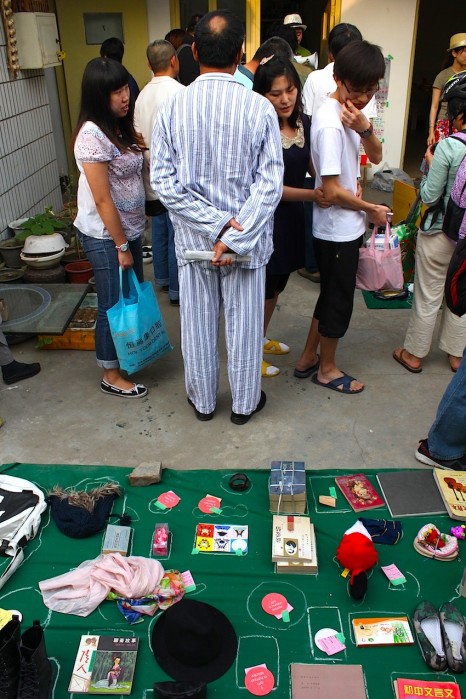
The neighboring Shouyi shop, photographed July 13th, 2012.


For the next meeting of Happy Friends Reading Club, we go on from the tensions between economies of perversion and play in Fourier and Sade, as elaborated by Klossowski, to investigations into varieties of the Utopian, with the first 2 chapters of “Archaeologies of the Future” (2005) by Fredric Jameson. 

The meeting will take place at HomeShop at 5 pm on Sunday, March 31st . If you would like to receive a copy of this book please leave a comment.


Get the Flash Player to see the wordTube Media Player.


家作坊有一张办公桌空出来了! 先到先得,请排队,勿推搡。
HomeShop has workspaces available for rent. First come, first served!

下载PDF文件可查看更多参与方法的细节。
Download PDF for more details about how you can participate, or just get in touch.


春天来了!起床,来城里种菜

在过去的两个星期,家作坊与北京都市农耕联盟的简明清准备了一个很NB的项目:复合养殖! 想法是在屋顶上构建一个鱼与植物的共生系统。具体措施是在一个面积15平方米的穹形暖室中,放置一个容量为2千升的鱼缸并在鱼缸的周围种植蔬菜。计划目前尚处于筹备阶段,在基本结构完成之后,我们会在下个月开始养鱼。如果你有种植,养鱼,工程设计,网页设计,翻译等方面的才华,并希望加入到这个项目中,那就尽管来吧。

3月9号(周六)下午两点,我们将在家作坊召开一个项目筹策会,给参与者介绍一下本项目与复合养殖的基本知识。超希望你的参与!欢迎!

Spring is in the air! Let’s wake up from hibernation and plant the city.

Over the last weeks, we (HomeShop and Beijing Urban Farmers Union’s Jonas Nakonz) have been preparing a pilot project for urban aquaponics in HomeShop. The aim is to grow fish and vegetables in an integrated system on the roof. So far, we’ve been gathering information and creating a rough design for a 2000 Liter fish tank and about 10m2 of vegetables, in a geodesic dome greenhouse. Now it’s a matter of refining the design, sourcing components, and starting to build. We hope to add fish to our tank within a month from now. We would be glad for any contribution of ideas/skills in gardening, fish farming, building, engineering, web programming, translation, etc. Everybody is cordially invited to join our learning journey!

We meet at HomeShop this Saturday, March 9th at 2pm for a kickoff meeting. For newcomers, the idea of aquaponics will be introduced. We’ll discuss where we’re at and how to proceed. With a little luck, we may be ready to build the greenhouse structure that day. (If we aren’t killed by sandstorms.)

北京都市农耕联盟
Beijing Urban Farmers Union


 家作坊的前屋太冷了,没人想在这里工作,那么我们怎样才能更好地使用它呢?“做一个长期的冰雕展览吧”,一个来自北海道的声音这样说到,而北海道正是以冰雪纷飞时的大型冰城著名的。那好吧,这里并没有那么冷,也许我们可以给它加热,并宣告战胜了北京冬天这个老冤家。于是,融冰节就这样诞生了。

Okay, okay, it started as a joke. The front room at HomeShop is so cold that nobody wants to work in there, so how can we use it? For a permanent ice sculpture display, said a voice from Hokkaido, which is famous for its huge ice castles during Snow Fest in Sapporo. Well, it’s not that cold, but maybe we could heat it up, and declare victory over our old enemy, Beijing winter? And so the Melting Ice Festival transpired.

《非社交游戏》 / Associalization

也许我们需要向大家清楚介绍一下“联想游戏”的玩法(回过头来看,这个游戏应该叫“非社交游戏”,不小心多加了一个s),其中部分是因为游戏 之夜将成为每月一次的活动。

规则如下:

桌子中央有大量带着图画的卡片。每个玩家拿6张牌,并不让其他玩家看见。轮到某个玩家时,他选择一张牌,可以用一个概念、词语、声音、句子或其他 方式向所有玩家描述这张牌,并将其牌面朝下放在桌子中央,其他玩家从自己手里的牌中选出与这个描述最相似的牌,并同样牌面朝下放在桌子中央。进行 描述的玩家要试图让至少一个其他玩家猜中他出的牌,但又不能让所有玩家都猜对(至少有一人猜错)。然后重洗桌子中央的牌,再把这些牌依次翻过来, 顺序排列。接着每个玩家投票,选出那张他们所认为是描述玩家所出的牌。最后的得分由票数决定。(如果至少一人但不是所有玩家猜对,该局的描述玩家 得3分;猜对描述玩家所出牌的其他玩家得2分;自己所出的牌误导其他玩家,一人/次得一分)

Perhaps some clarification is in order to explain what happens in the game Associalization (which, looking in the rear-view, should technically actually be called Asocialization, but was subject to an asinine Freudian slip), partly because game nights will become a monthly tradition at HomeShop (says the erstwhile Dust Bar proprietor). Stay tuned and join next time!

Rules work this way:

There are a large amount of cards with drawings on them. Each player gets a certain number of cards, for example 6.  Players’ cards are hidden from one another. The player whose turn it is chooses a concept, word, sound, sentence etc. for one particular card, announces it to all players, and places the card face-down. Their intention is for at least one player to correctly guess their card, but at least one player who does not correctly identify. Other players check their own hand for cards that could possibly correspond, and put these down. The cards are shuffled, and finally flipped to reveal the images. Then each player votes on which card they think is the the originally chosen one, and points are allotted depending on the distribution of votes (3 points to the player whose turn it is, if at least one but not every player chooses their card; 2 points to the player who chooses the correct card; 1 point to the player who has fooled others with an “incorrect” card.)

规则很简单,苹果也会玩。

It’s so easy, apples can also play.


冷凝混音(第1场) / Condensation Sound Collage (Stage 1)

Get the Flash Player to see the wordTube Media Player.


冷凝混音(第1场)是一场简单的录音过程,录下人们对一些关于家庭和家人声音的问题所做出的答案,在未经剪辑的情况下直接多重覆盖。

Condensation Sound Collage (Stage 1) was a simple process of recording people’s responses in private to a number of questions about sounds their families make, unedited and overlaid.


袖珍“哈尔滨彩色冰雕”扮靓家作坊 / Little Harbin highlights

乔治·华盛顿与蛇 / George Washington with snake

爸爸 / Father

小妹妹和叔叔 / Little sister and uncle

 妈妈和小孩子 / Mother and baby

嘀嗒嘀嗒嘀嗒嘀嗒


Get the Flash Player to see the wordTube Media Player.


《高山流水》赵天汲

High Mountain, Flowing Water by ZHAO Tianji

(声音装置 / sound installation)


2月1日 星期五 7:00点 / Friday, February 1st, 7:00 pm

“融冰节”

春节近至,在我们必须回家团圆之前,家作坊将举办一次自由联想的夜趴。

子曰:欲治其国者先齐其家。

拉康也说过:“由于基于婚姻建立的家庭结构会在下一代中成为权威的化身,往往与某家庭角色联系起来,因此它势必将自身的权威放到创造性颠覆触手可及的地方。”

德勒兹 瓜塔里又说:“不是说俄狄浦斯与阉割等啥也算不上,我们都被俄狄浦斯化、被阉了;不是说精神分析学发明了这些进程,并且天才地赋予后者新的源头与方法。但 这是否就能将欲望生产的尖啸化为无形:我们都是精神分裂者!我们都是变态!我们是力比多,不是太稠就是太稀,不是我们愿意这样或那样,而是解辖域流把我们 卷入其中、随性抛掷的结果。”

站在龙年的尾巴上,让我们再聚一次,体味与家人、与自己之间琢磨不透的关系

活动:冰雕融化展示, 联想卡片游戏(参照一款流行桌游“只言片语”自制的家作坊版),冷凝混音,微尘之吧

Melting Ice Festival

HomeShop hosts an evening gathering of free association just before we all depart for the enforced association of Spring Festival.

As Confucius said, “The strength of a nation derives from the integrity of the home.”

And as Lacan said, “Because the conjugal family incarnates authority in the next generation and in a family figure, it puts this authority within the immediate range of creative subversion.”

And as Deleuze and Guattari said, “We are not saying that Oedipus and castration do not amount to anything. We are oedipalized, we are castrated; psychoanalysis didn’t invent these operations, to which it merely lends the new resources and methods of its genius. But is this sufficient to silence the outcry of desiring-production: We are all schizos! We are all perverts! We are all libidos that are too viscous and too fluid-and not by preference, but wherever we have been carried by the deterritorialized flows.”

Let’s meet once more before the end of the year, and savour our ambiguous relations to family, and to self.

Events: Melting Ice Sculpture Display,  Associalization card game (HomeShop’s own version, similar to the popular Dixit ©), Condensation sound collage, Lubricative Dust Bar.


HomeShop recently participated in the exhibition Green Box - Remapping — The Space of Media Reality (organized by School of Intermedia Art of China Art Academy at Media City Research Center 11–29 January, 2013) with a just-in-time newspaper about the other works in the show, silkscreen-printed on-site in the exhibition space.

近期,家作坊参与了展览《绿盒子-重绘形貌-媒体现实的空间》(由中国美术学院媒体城市研究中心举办,于2013年1月11-29日展出),作品为一份关于本次展览中其他作品的即时报纸,在展览现场进行丝网印刷。

两年以来,家作坊通过报纸的形式对公共性与本地性的“内”与“外”进行持续研究,包括《黄边日报》与《北二条小报》。我们意在通过时效性媒介来发表一个具有复调空间的宣言。从时间与空间上来说,报纸的截稿时间给内容强加了一种特定的紧迫感。 

作为这些表演性新闻报道的延续,《绿盒子阜利通》将现身《绿盒子:重绘形貌-媒体现实的空间》群展,并展开探索。家作坊小分队会对其他参展者进行纪录、注解、批评,搜集大量数据、真相抑或流言,以及深入幕后的主观诠释,这些将以红墨印制,在开幕时供人取阅。在个别情况下,参展者可选择自我批判,而不是让作品任由《绿盒子阜利通》支配。最后,我们的社论不仅是指向自我的检视,渗入自身实践的诸多边界,而且是向普遍意义上的展览批评提出质询。

For the past two years, HomeShop has been investigating the ins and outs of publicness and locality through the form of newspapers, including The YellowSide Daily and Beiertiao Leaks. The intention has been to form a multi-vocal space of statement through a medium of urgency. The newspapers’ deadline forces a certain immediacy of content, in both time and place.

Greenbox Leaks is a followup on these exercises in the performance of journalism, turned toward the exploration of the context of the group exhibition in which it will appear. A team dispatched from HomeShop will document, annotate and critique the contributions by all other participants in the show, gathering meta-data, truth & rumour, and subjective interpretation into a special behind-the-scenes critical feuilleton to be printed in red ink and available for the opening. In some cases, the other participants will be offered the choice to self-critique instead of having their work subjected to the treatment of Greenbox Leaks team. Finally, our editorial comprises a self-criticism that not only infiltrates the boundaries inherent to our own undertaking, but also problematizes all future criticisms around the exhibition as a whole.

Printing past the deadline at the opening. 开幕之后的现场印刷


Fellow artist in Green Box, Liu Guoqiang, takes his criticism with admirable humour. 另一位参展艺术家刘国强带着崇拜式的幽默阅读关于他的作品的批评


The presentation also included previous editions of Beiertiao Leaks, YellowSide Daily, and 《穿》Wear journals (now available in Hangzhou while supplies last!). 展览的作品也包括前期的《北二条小报》《黄边日报》《穿》

Counting the hot cakes profits (1 yuan x 66 copies sold = 66 yuan!) 清点我们的收获!(1元*66份=66元!)


Read Greenbox Leaks here
在此阅读《绿盒子阜利通》

See more here: 更多信息 http://weibo.com/u/3205118847?topnav=1&wvr=5&topsug=1


The next meeting of the Happy Friends Reading Club will take place at 5 pm on Sunday the 27th of January, 2013, at HomeShop.
We will be reading Pierre Klossowski’s “Living Currency” (1970).

Please leave a comment to receive a copy.


“如果你爱他,就把他送到纽约去,因为那里是天堂;如果你恨他,就把他送到纽约去,因为那里是地狱。”
If you love her, send her to New York, for there it is heaven; if you hate her, send her to New York, for there it is hell.

地点 location:家作坊 HomeShop
时间 time:2013年1月5日,星期六,全天,中午开始  Saturday, 5 January 2013, from 12 noon all day

家作坊邀请你沉浸在一整天电视剧的节日综合症中。我们将于一月五号星期六,实现马拉松式的观看完整部九十年代电视剧《北京人在纽约》。这个著名的肥皂剧讲述一位北京音乐家和他的妻子在纽约的磨练和患难编年史。

 电视剧取材于1991年出版的曹桂林的同名小说。在小说畅销和北京晚报的连载后1993年中央电视开始制作由导演郑晓龙、冯小刚和明星姜文出演的电视剧《北京人在纽约》,它是第一部在美国拍摄的中国电视剧。

影片引发关于中国人背井离乡在纽约这样的新环境的一系列大讨论。不可避免地讨论到文化交流,权力关系和美国梦。我们中的许多人都是外籍人士,它提供给我们关于反向想象的在北京的经验。

我们将在中十二点开始,连续播放整个25集。外加供应全天的毯子和(加咸黄油的)爆米花。欢迎各位带来各种小吃和啤酒一起分享。

HomeShop invites to you to indulge in a day of post-holiday TV watching. We will spend Saturday, January 5, attempting a marathon viewing of the complete run of 90s television series “A Beijinger in New York” (北京人在纽约). This well-known soap opera (or “opera soup,” as our friend Pilar says) chronicles the trials and tribulations of a Beijing musician and his wife after they move to New York City. 

 The soap opera is based on a book of the same name by CAO Guilin (曹桂林 Glen CAO) published in 1991. After the success of the book’s sales and subsequent serialization in the Beijing Evening News, CCTV began production of the television series in 1993.  Directed by ZHENG Xiaolong and FENG Xiaogang, and starring JIANG Wen, “A Beijinger in New York” was the first Chinese television series filmed in the United States. 

The TV series opens a larger discussion about leaving home and trying to “make it” in a new place as an image of New York as imagined by Chinese expats is revealed throughout the series. Inevitably discussions about cultural exchange, power relations, and the American Dream arise. Many of us are expats ourselves and the reverse imaginings provide a counterpoint to our own experiences in Beijing. Join us as we dissect constructions of other places. 

We will start screening around 12:00 p.m. and view all 25 episodes. Extra blankets and popcorn (salty with butter) will be provided all day. Feel free to bring snacks to share and/or beers to drink.