请登陆我们的网站首页  VISIT THE MAIN HomeShop SITE

Posts tagged ‘跟踪 tracing’

Get the Flash Player to see the wordTube Media Player.
即兴MV:White Hinterland乐队的“Vessels” (或者叫“家作坊的冬天”)
“Vessels” by White Hinterland, an instant music video (or, HomeShop in winter)

This comes in the after effects of our reading group discussing Claire Bishop today, a contestable figure in the realm of participatory art practices today, we fall in and out of line. We discussed quite a bit about the different politics of maker/audience relations, the possibilities and limitations of criticism (or the lack thereof) amidst the alternating roles of curator, artist and audience. Whether it’s about critique or pure naiveté, what necessarily emerges in this triangulation is the question of community. Who is speaking to whom, and does that relationship generate community, make it elitist, or raise propositions to completely unpredictable others? We move from the Argentinians who use socially engaged art to motivate participants to push forward in the realm of the socio-political, to the Eastern Europeans and Russians who evade the directly political for a meta-political alter-realm of the sensible, to ourselves. Dialogue evinces a form of self-reflexivity that cannot conceptualize self without other, a 对方. Is that 对 antagonistic, or, like the best love letter i ever received, simply… “Yes.”? 对 Duì, in that Chinese sensibility, pragmatic, like its ‘寸 hand’ on the right and in the traditional 對, where on the left 业 industry stands over 王 rulership. Our being in place is oppositional, but insofar that we do in order to be relative to others (power). And if those power struggles are not finite, we have a form of agonism that does not value one way over an other, but in its perpetual instability, the way itself. This ‘way‘ is meta-politics, it is aesthetics, and perhaps, it is from here the beginning of a research into style. Style here cannot be separately conceived from its actors or audiences, and perhaps, it may be one of the last remaining realms where the spectator possesses the most valuable rights of critique towards an author who does not see him/herself (is that democratic?). So who is the curator here? The media, the mob, or the system itself? That which cannot be critiqued in and of itself is power, is the stampede sparked by inadvertent incident, where action supersedes any one intention or attempt to communicate. Style is only manifestation, it is the superficialness of the masses, it is a form of representation that both critiques (bitchy) and evades critique (inessential). So to go from there, it seems possible to start from two cultural forms of analysis: one, fashion and semiotics, starting from Barthes and moving forward, and then, translation as a mediator of meaning. Maybe thereafter, something more spiritually or politically charged, but that will come upon further introspection of what that “we” really meantUntil then…

Get the Flash Player to see the wordTube Media Player.
森林(Céline)拍的即兴教育短片:吴思远学英语,小欧学汉语(“家作坊,现代的巴别塔,在那里,在学习对方的语言的积极性,新奇特生命形式的语言出现……”)
“Ray studies English, Orianna studies Chinese”, an instant educational video by Céline LAMÉE (“HomeShop, a contemporary tower of Babel, where, in the enthusiasm of learning each other’s languages, strange new lifeforms of languages emerge…“)


一个周六的北京城217.6公里狂走送货上门纪录:
material captured during our Saturday deliveries of WEAR journal in Beijing city, otherwise known as 217.6 km later…:


Get the Flash Player to see the wordTube Media Player.
早上 9:30 AM | 吴思远 Ray & 高灵 Ling | 菊儿胡同 Ju’er Hutong、左家庄 Zuojiazhuang、汉庭酒店(东直门外分店)HanTing Express Hotel (Dongzhimen Outer branch)


Get the Flash Player to see the wordTube Media Player.
早上 10:00 AM | 何颖雅 Elaine & 小欧 Orianna | 清华大学美院 Tsinghua University, Fine Arts Department


Get the Flash Player to see the wordTube Media Player.
早上 11:00 AM | 天汲 Tianji & 左罗 Zoro | 东直门外大街 Dongzhimen Outer Street


Get the Flash Player to see the wordTube Media Player.
中午 12:00 PM | 王尘尘 Cici & 王大川 River | 东四八条 Dongsi8tiao、地安门 Dianmen、旧宫地铁站 Jiu Gong subway station


Get the Flash Player to see the wordTube Media Player.
下午 1:00 PM | 高蓓 GAO Bei & 七朵云 Pilar | 苹果派社区 (东5和6环之间) Apple Pie Estates (between the 5th and 6th East Ring Roads)


Get the Flash Player to see the wordTube Media Player.
下午 1:30 PM | 王若思 Rose & 森林 Céline | 望京 Wangjing、草厂地 Caochangdi


Get the Flash Player to see the wordTube Media Player.
下午 2:00 PM | 欧阳潇 Xiao & 小欧 Orianna | 幸福西里 Xingfu Xili、东直门内 Dongzhimen Inner Street


Get the Flash Player to see the wordTube Media Player.
下午 3:00 PM | 曲一箴 Twist & Katharina | 鼓楼西大街 Drum Tower West、鼓楼后面 Drum Tower North、鼓楼东大街 Drum Tower East


Get the Flash Player to see the wordTube Media Player.
下午 3:00 PM | 张献民 Frank & 何颖雅 Elaine | 卢沟桥 Marco Polo Bridge、东五道口 Wudaokou、奥林匹克公园北门 North Gate of Olympic Park


制作已花费了很长时间,我们一直在努力将已有的资源整合并分享,现在是收获的季节 啦:
www.homeshop.org.cn 或者 www.homeshopbeijing.org 。
由于网站包含众多内容,访问时请耐心等待…

点击链接访问家作坊的新网站之后,您可在四周活动一圈,做下伸展运动或者泡杯茶,网站正在加载中——慢工出细活——需要时间…

最后,站在兔年的尾巴上,家作坊祝大家龙年“张牙舞爪”!

It’s been a long time in the making, but here we are, an attempt to gather together and share some of what we do:
www.homeshop.org.cn or www.homeshopbeijing.org.
There’s a lot of space in-between; please visit and stick around…

Go ahead and click on the link to visit HomeShop’s brand new website, then take a small walk around the room, do some stretching exercises or make tea; this website is a work-in-progress, and—like all good things—takes time…

But don’t let that stop us from multi-tasking——Michael, 何颖雅 Elaine, Fotini, 欧阳潇 Xiao, 曲一箴 Twist, 植村 絵美 Emi and 王尘尘 Cici at HomeShop wish you all fierce flights and a happy Dragon year.


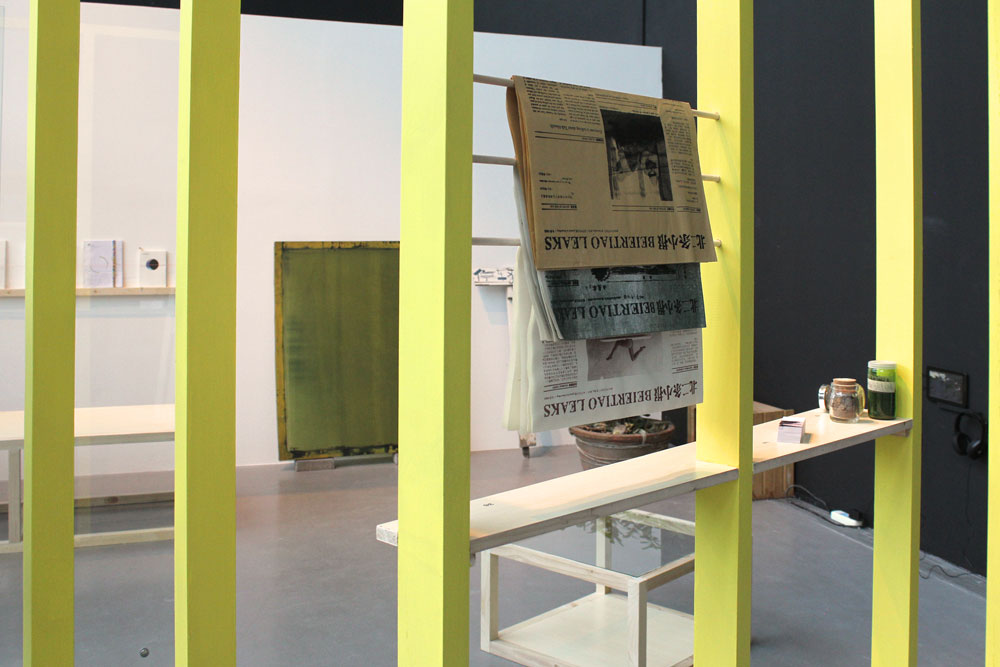
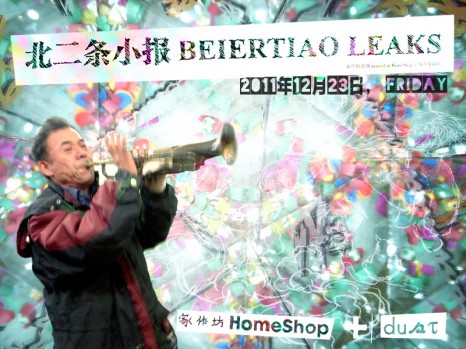
已经到了一年两期《北二条小报》印刷的最后期限,新一期即将出炉!借着家作坊入住交道口北二条一年的良机,新闻工作人员将对我们驻地媒体传播者的角色进行反思,这种反思是微型群体与城市的对话,艺术界的内部八卦,或一种试图理解和过滤当代地缘政治的尝试。

诚邀你参与我们这项带有北京胡同风格、对媒体和交流进行的调查,你可以以记者、编辑或撰稿人的身份参加。在市政府出台了一系列市场调控政策之后,哪里是安定门最热闹最隐蔽的地方?什么是堵塞交通或占领胡同内公共空间的最创新方案?为什么范老师不再对着墙壁打乒乓球了?

这周五中午12点之后来家作坊逛逛,与我们一起参与这份特别的本地报纸出版工作,大功告成后与我们的出版团队共饮。DUST bar 是家作坊的内部酒吧,提供威士忌及概念性故事游戏,以保证我们的新闻工作者们能够高效地运转。

概念青年旅舍[再现17岁]将组织有趣的饮酒游戏和“真实经历”交换活动。最佳故事讲解员将获得免费鸡尾酒一杯及其他惊喜。

出版工作室开放时间为12月23日(周五),从中午12点至晚上8点。DUST bar 开放时间为晚上8点至深夜。所有收入将用于家作坊的后续公共活动。非常感谢你的支持!

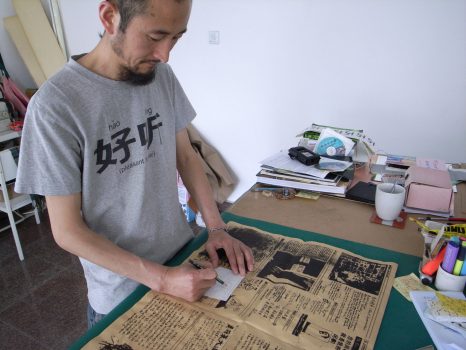
我们将利用周末两天时间完成报纸得制作与印刷,欢迎 任何对丝网印刷的基本技巧感兴趣的朋友在此期间加入我们。 第三期《北二条小报》将于12月25日之后发行,别着急!


BEIERTIAO LEAKS has reached its impromptu biannual print deadline——time for a new edition! Coinciding with the one-year anniversary of HomeShop’s residency at Jiaodaokou Beiertiao, news staff are taking this opportunity to make a critical reflection of our role as embedded media purveyors both in and outside of the local scene, whether that encompasses a small community in Beijing, art world gossip, or an attempt to understand and filter contemporary geopolitics as a concurrent reality.

You are invited to participate as reporter, editor and copywriter for our ongoing investigation into media and communications in Beijing hutong style. Where is the hottest hidden property in Andingmen after the stern hand of market control takes hold over Beijing? What are the latest creative schemes to block traffic and usurp public space in the alleyways? Why doesn’t FAN laoshi play ping-pong against the wall anymore?

Drop by HomeShop this Friday anytime after 12 pm to participate in the production of this unique local newspaper, and stick around after work hours for a drink with the press team. The DUST bar is embedded in-house for maximum efficiency, with whiskey and conceptual storytelling to keep our newshound teeth sharp and hungry.

The Conceptual Youth Hostel [Prototype 17] will play host to fine drinking games and “real experience” exchange, with free drinks and a round of other surprises to the journalist-narrators with the juiciest LEAKS.

The pressroom is open on FRIDAY, 23 DECEMBER from 12 NOON to 20.00. The DUST bar opens from 20.00 until late.  All proceeds go toward supporting the public activities of HomeShop; your support is greatly appreciated!

Presses will run all weekend at HomeShop, and anyone interested to learn basic silkscreening processes is welcome to join. This third edition of BEIERTIAO LEAKS will be available for pick up and delivery after the 25 December, easy going!

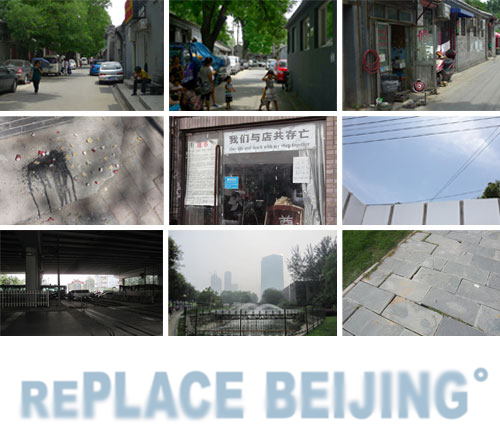
photos taken by GB, ME and ES along their daily route.

参与方式即在http://beijing.re-place.info提交你的路线。Participate now by submitting your own route online at http://beijing.re-place.info.

生活的仪式每天都在街道和建筑中沿着固定的轨迹运行,将建成环境中虚虚实实的空间整理成各种故事与街区形态的组合。因为被记忆和社会仪式复杂化,我们所体验到的城市变成了一个动态的场所,一个公共表演的舞台和各种私密的悲剧,变成了许多有意义的时刻和不可理喻的世俗。各种习惯、仪式、人们的行为和生活经验把城市定义成了一种总处于当下的、保持不变的和随机的运动。

延续了PROGRAM和Transit Lounge在2007年发起的rePLACE柏林项目,北京的活动开始于一个公共的邀请,目的是去重新认识 作为一个与日常生活经验息息相关的,对时间与场所的动态记录的城市。

你的参与应该是一个个体的贡献,最终组成对整体城市直白又隐晦的摆动方式的理解,以及对那些与本土的、个人知识、故事、记忆、神话相似或者不同的路的理解。

任何人,只要是在北京,都可以通过标出一条每天经常走的路,并记录下沿途的固定场景或者特定时刻参与进来。只需要根据提示上传你的路线和你途中观察发现所记录下的文字、图像、视频以及/或者录音。 你也可以参与别人准备好的”组团旅行”,只需要下载任何已经上传好的PDF地图并重新体验别人每天的固定路线。

通过项目的不同阶段,rePLACE希望提供一个了解城市的方式,不仅通过它的建成环境,而且通过城市居民每天与它进行的互动——我们遵循的那些路径,以及它们相交、叠加、平行或相切的每个时刻。这最初这是一个对历史和图像制造超出我们传统解读的部分的重新思考,也就是各种形式的遗产保护可以超越被动的被历史化,从而形成一个积极歌颂变化的城市的鲜活过程。

The rituals of everyday life trace regular paths along streets and through buildings, organising the solids and voids of the built environment into narratives and patterns of association. Complicated by memory and social rituals, our experience of the city is of a dynamic place, a stage for public performances and private tragedies, of significant moments and the incredibly mundane. The habits, rituals, and actions of its population, the lived experiences within the city define it as something that is always current, always in constant, random movement.

rePLACE BEIJING begins by a public invitation to reconsider the city as an active process of documenting time and place inseparable from our everyday, lived experience. Your participation is requested as a singular contribution towards an alternative, collective understanding of how the city both literally and metaphorically vibrates, or where ‘the beaten track’ runs rich with/counter to personal knowledge, memory and cultural myth.

Please join rePLACE by mapping out a frequent route from your day-to-day life. Record the regular patterns and particular moments associated with your journey, then simply follow the instructions to upload your route as well as text, images, video and/or sound documenting observations and discoveries made along the way.

Through the various stages of the project, rePLACE seeks to provide a way to understand the city, not only through its built spaces, but in the ways its residents are interacting with it in their daily lives — the routes we follow and the moments where these routes cross, overlap or run tangent to each other. This is foremost a reconsideration of history and image-making outside of our traditional understandings of these terms, where forms of heritage preservation can go beyond passive historicisation and generate living processes to actively celebrate the city-in-flux.

rePLACE柏林是一个由PROGRAMTransit Lounge于2007年发起的项目。 2011年的rePLACE由Daniel Berndt、何颖雅与Fotini Lazaridou-Hatzigoga组织。rePLACE柏林和rePLACE贝鲁特由Anna Lindh欧洲-地中海文化交流基金会、 阿拉伯图片基金研究中心以PROGRAM支持。rePLACE北京由家作坊支持。 更多的信息请e-mail联系: mail[圈A]re-place[点]info
rePLACE is a project initiated in 2007 by PROGRAM and Transit Lounge. rePLACE in 2011 is organized by Daniel Berndt, Elaine W. Ho and Fotini Lazaridou-Hatzigoga. rePLACE BERLIN and rePLACE BEIRUT are supported by the Anna Lindh Foundation, Prince Claus Fund for Culture and Development, the Arab Image Foundation and PROGRAM. rePLACE BEIJING is supported by HomeShop and PROGRAM. For more information please contact: mail[at]re-place[dot]info

all photos by 曲一箴 Twist QU*

If we had not been able to come closer to an understanding of affect at the reading club meeting, it came to me again in a recent text by another Brian (“The half-life of disaster“), where somehow the descriptive traversing of scales felt familiar, and of course it can hit us with as much impact as watching a slow-motion montage of the year in review, or Olympic triumphs, or yes, the touching moments and heroes of disaster. We should be immune already perhaps, cynical viewers whose forms of belief have decayed parallel to these half-lives, and yet even at standstill, reduced to its barest linguistic denominators, it could still be possible to induce a notion of affective scales on a billboard covering an urban construction site: “Grandpa lazing in the sun. Boys dancing hip-hop. Businessman checking e-mail. Woman carrying shopping bag.” She was kind of pissed off about this, about all that it left out or pinned down too characteristically in succinct world view, but it seemed also something more than ‘trace’ in a collective reading on media. This is an affect of the kind that Michael mentions, “understood as the embodiment of certain codes, to be read and embodied by a particular community”. Such embodiment is a continuous training, like watching these disasters in constant cycle, like urbanity itself. We learn to traverse the levels, moving from horror and shock at grand scale to human warmth and its accompaniments in the everyday heroes and miniature miracles that soothe a constant, half-toned fear.

Taking distance can occur in both directions, towards macro-scale world views or into the safety of the small moments in a day to day. What Massumi claims as a ‘trace-form anticipation’ singularly and collectively describes this back and forth motion; it is a kind of subjective being-in-motion that typifies our here and now condition. To make a hero of our friend A W W abroad stresses the silence nearby, it casts scales of individual activism helplessly against nameless foreboding forces at the state realm, naïvely paralleled by his name being coded “Love the future”. Larger and stronger pursuits of activism in the last years (in education, in the art world, the Middle East, the mid-West…) echo, or are symptomatic of such “affective conversion circuits”, but there remains to be seen what “alter-” could possibly step out of it. Should affect move out of affect? What lies outside of scale itself? The movements seem to encompass everything already, like fantastic ideas kept to oneself, like capitalism’s neverending ever in sight, like half-lives in decay.

—–
* there was a thought at the beginning of writing this post that these photos bore some relation to the things i was going to say, but the distancing ended up there. there is a lot of ambivalent feeling in their transmission, but they speak of a relation…

Get the Flash Player to see the wordTube Media Player.

The ‘Blood Real Estate Map’ which sparked huge interest online in the last months came to my knowledge in the real space of my living room. It’s kind of messy here these days, as preparations to move out of the small grounds at Xiaojingchang are underway for a lateral shift towards Beixinqiao, but a friend stopped by one evening with the kind of hushed urgency of a very important favour to ask. She was asked by a wishing to remain anonymous contact of hers to help translate a response text about his initiative documenting violent incidents linked to forced demolition and eviction. She needed my help for the translating and proofreading, and so another late night at HomeShop rolled cultural exchange, an attempt to map the current condition and maybe a little bit of exaggerated or not ballsy-ness (you have to keep quiet about this, he’s at a lot of risk and we don’t know what may happen) all into one.

The Blood Real Estate project, which was launched at the beginning of October, consists of two Google maps:

the revised version [note: use proxy to access], which is edited by the founder and shows only verified cases, and an open version [note: use proxy to access] that anyone can add to or edit. Little volcanoes represent sites where people were evicted violently, with water canons or Molotov cocktails.  Beds indicate incidents that resulted in at least one death. [France 24]

The map maker felt a personal response to foreign media was necessary because of all the publicity generated by his work, and while proofreading his text I was surprised to find such an emotional personal declaration to clarify an action of anonymous digital tracking (though the wiki-version feels much more dramatic). The calm reflection he claims results from this project sounds more spiritual than practical, more self-intuited than strategically outlined. Not that anyone has any answers. Blow-up is blow-up, whether it is someone’s home, publicity or real and imminent threat.

Below is the full version of his text “Believe in Tomorrow”, first published in an edited version at France 24 International News:

(more…)

I recently ran into this mini project from students of FEI Jun‘s media lab at the Central Academy of Fine Arts (courtesy of NO+CH). They call them “micro-observations”, and according to the students, serve “not merely as a magnification of the thing itself, but as an enlargement of the act of noticing. ‘Micro-observations’ bring about not only a paying attention to the unnecessary, but in revisiting these objects the transformation of their semantic meaning.” Nice public intervention~

点击图片查看箭头指向的物体 Click on the images to see enlarged object

“微观”公共艺术项目

材料:水、粉笔、现成品

人们似乎只习惯关注宏观风景,而忽略身边的细微之物,尤其是在公共环境中。指向性的标识符号往往对人产生直觉性的吸引力,我们在公共空间中使用粉笔、水等创建了临时性的导视符号,用于指向日常环境中的一些微小的物件,墙角的昆虫躯体、地上干枯的残花、马路上散落的烟蒂…叠加的标识使得这些平常无奇的细节被人为的放大,其实被放大的不是物件本身,而是人们的关注,“微观”导致的不只是一次可有可无的关注,被关注的那些物这样的再访中被转化了语义。作为对于特定公共空间的一次微小和瞬间的干预,“微观”企图引发“再访-再现-再定义”的感知体验。

参与艺术家 Participating artists:费俊 FEI Jun、尚钰 SHANG Yu、宋思琪 SONG Siqi、张宝珠 ZHANG Baozhu

that’s the artist who gave the workshop in Geneva last month:

http://www.softhook.com/

His name is Christian Nold and he has been working mainly on public space and particularily how “masses” use and move into space. As he says, nowadays, there are so many events happening already in the public space (for example, protests, etc.) that there is no need to organize events or performances. there is enough to observe already. what he has been mainly doing in recent years, is to produce subjective cartographies of areas, cities, etc. He made kind of emotional maps, for example, renaming all the subway stations, or he asked people to draw their neighborhood…in another project, he asked people to walk around with a kind of machine that measures stress (like a lie detector) and a gps, and afterward they discussed together to understand what were that main reasons for stress. actually his maps look like the one I posted last summer on our blog…

I think the whole point of his work is to give community a voice to express its own space, and to personalize maps instead of having objective, pseudo-neutral maps. somehow, I felt that his work is trying to put together the two dimensions of mapping and tracing…I gave him Petrescu’s paper, he was interested! His work goes sometimes a step further, in the sense that it is used by urban planners or local politics, who need to have a better understanding of the environment.

The work we did in Geneva was quite different though, and although i found it interesting, it was somehow too similar to what I’m used to do in social sciences. we chose an area we wanted to explore, describe and map, and we ended up working on the UN/international organizations area, which is a very special area in Geneva as it is very cold, unfriendly and unlively area. almost like the bad chinese new constructions you see everywhere.

http://www.geneva.publicbiopsy.net/?page_id=105

well, so as we could feel it in the built environment, we tried to explore the connections/disconnections between this area, the people working in those IO and Geneva. Basically a lot of those people are expats, so they have a particular relation with the city, as expats have everywhere else in the world. but what at least for me is interesting, is that all those IO, NGOs, etc. are kind of acting for the world, that is, in a scale we all belong to. But as I showed on the pictures (the world upside down that I posted a few weeks ago) there is something very weird about the world they represent: something that is far, stranger, cold, that nobody seems to be able to appropriate, and this is strongly felt in the built environment. So during the workshop we got kind of stuck with this very huge topic of international organizations…and tried to map them, or at least tried to map their presence into the city, but we didn’t really have enough time to finish…so the result wasn’t that interesting. it was funny though to interrogate people about those IOs; we asked them to draw the people working there and get a bit into their imaginary of what those guys are (doing). I think it could have been funny to try to imagine the city actually without its international part and see what would be left…but I think these drawing and mapping techniques are definitely very interesting and could be something to explore in Beijing projects as well…

and here is my question, the post about electric palm tree is very interesting, how do you imagine we could get further on the co-existence discourse? do you already have some ideas in mind?